
Just a moment…
Just a moment…
Millions of people pay close attention to their hair and scalp, whether it’s out of concern for hair loss, skin conditions, or simply maintaining healthy hair. Today’s research is shining a light on how complex hair, skin, and nail biology really is—and why seemingly simple solutions don’t always have the effects we hope for.

Psoriasis affects many, and when it targets the scalp, it’s especially stubborn. Until recently, scientists didn’t fully understand why the scalp is so vulnerable. But a new study published in the British Journal of Dermatology set out to explore this question by focusing on hair follicle cells.
The researchers analyzed both healthy and psoriatic scalp skin using advanced genetic tools, including bulk, single-cell, and spatial transcriptomic techniques. Their main goal: to identify which cells and signals might be driving inflammation in psoriatic scalp skin.
They discovered that a specific group of hair follicle cells with high keratin 17 (K17) expression—called “K17hi” cells—appear to play a key role. These cells seem to orchestrate inflammation via S100A1-dependent signaling pathways. In simpler terms, certain hair follicle cells may actively contribute to the inflammatory process in scalp psoriasis, rather than being passive bystanders.

This finding helps explain why psoriasis is often stubborn and recurrent on the scalp. It also opens up new possibilities for targeted therapies that focus on the unique biology of hair follicle cells. While this research was conducted at the cellular and molecular level (not as a clinical treatment trial), it highlights how hair health and scalp inflammation are deeply intertwined at the root—quite literally.
Biotin is everywhere—marketed for hair growth, stronger nails, and even as a way to combat hair loss from medical treatments. But does it live up to the hype? A recent ScienceDaily report highlights serious concerns about biotin supplementation, especially for cancer patients.
Many people coping with hair loss from cancer therapy turn to biotin, hoping to speed regrowth. However, experts warn that there’s little scientific evidence showing biotin helps with this kind of hair loss. Even more concerning, biotin supplements can interfere with laboratory tests, sometimes distorting important blood markers that doctors use to monitor cancer or other health conditions.
This interference isn’t limited to cancer care. Anyone taking high-dose biotin should inform their healthcare provider before having lab tests, since the vitamin can affect the accuracy of several common assays. For most people who get enough biotin from their diet, extra supplementation is usually unnecessary unless directed by a healthcare professional.
Most lumps or bumps under the skin are harmless, but a rare benign tumor called pilomatrixoma has an interesting connection to hair matrix cells. According to a recent article in Skin Health and Disease, pilomatrixomas are typically isolated and harmless. However, when multiple pilomatrixomas appear—especially in children or adults—they can sometimes be the first sign of an underlying genetic syndrome.
These tumors originate from the same type of cells involved in hair growth, showing once again how hair follicles can reflect broader health patterns. If someone develops multiple pilomatrixomas, doctors may recommend further evaluation for associated genetic conditions.
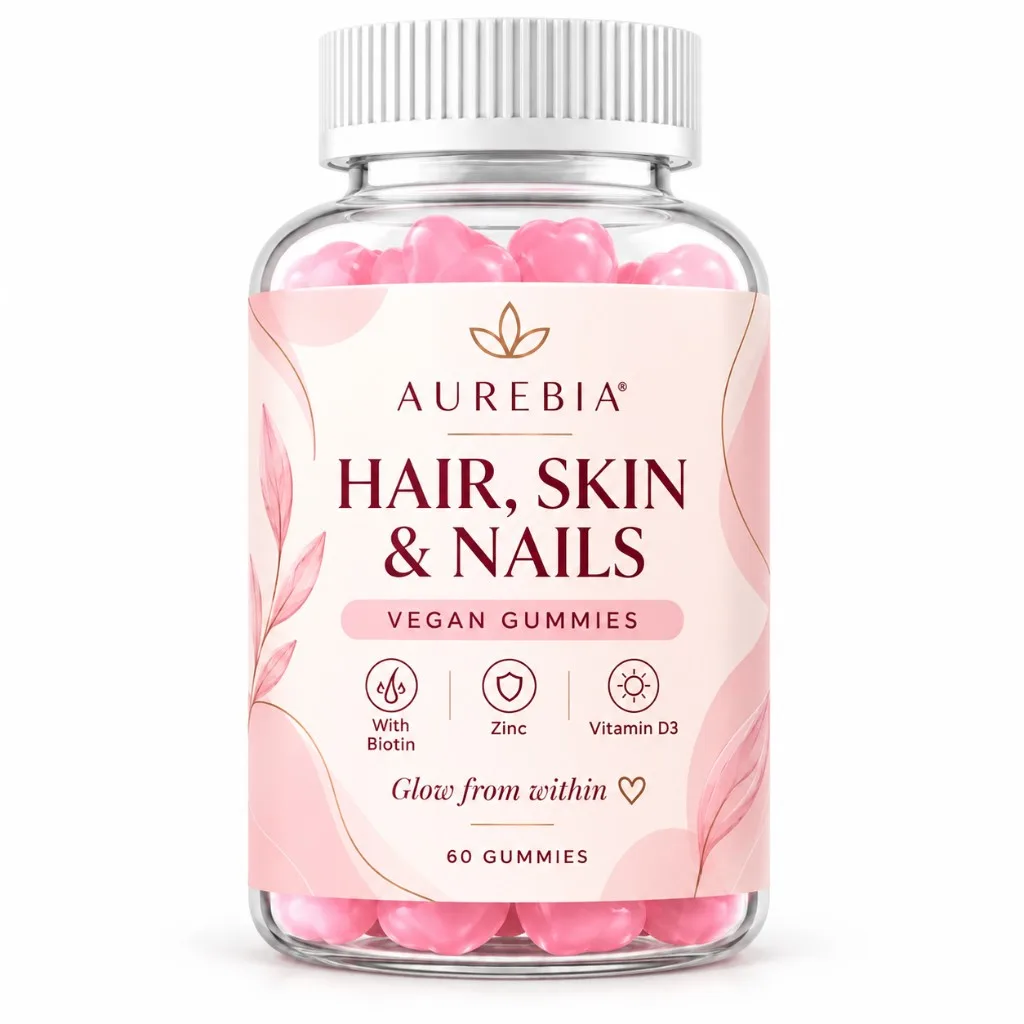
If you’re looking for ways to maintain normal hair, skin, and nail health, it always helps to understand what the science really says. The Aurebia Vegan Gummies formula is simple and focused. Each daily serving provides:
The routine is straightforward: one gummy in the morning and one in the evening. A 90-day introductory order includes three bottles (180 gummies) for $99—no automatic subscription during the initial period. Learn more about the formula at aurebia.health/product.

There is little scientific evidence that biotin supplements help with hair regrowth after cancer therapy. Speak with your healthcare provider before starting any new supplement, especially during cancer care.
Pilomatrixoma is a benign tumor derived from hair matrix cells. It is usually isolated and harmless, but multiple tumors may warrant further medical evaluation.
Yes, zinc contributes to the maintenance of normal hair, skin, and nails when consumed at recommended levels.
Yes. High-dose biotin can distort some blood test results, so always inform your doctor or laboratory if you are taking biotin supplements.
If you’d like a clearer idea of how Aurebia’s routine might fit your hair, skin, and nail goals, answer a few short questions and get your tailored plan and ordering path at aurebia.health/quiz.

4 min read · OCT 21, 2026

5 min read · OCT 20, 2026

5 min read · OCT 19, 2026